

New MapBiomas data also shows how soy ceased to be one of the main drivers of deforestation after the Moratorium
September 15, 2025
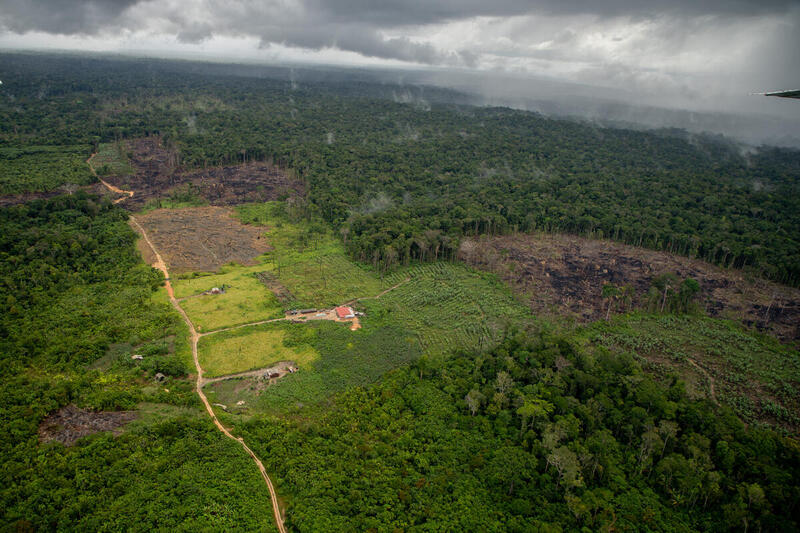
The Amazon is the largest biome in the country. With 421 million hectares, it occupies nearly half (49.5%) of the Brazilian territory. Between 1985 and 2024, 52 million hectares (-13%) of native vegetation area were lost. This is revealed by the latest Amazon data from MapBiomas Collection 10 of land cover and land use maps. The survey, conducted through satellite imagery analysis, shows that this suppression primarily affected forest formations, which lost nearly 50 million hectares (49.1 million) over the last 40 years. In 2024, native vegetation covered 81.9% of the biome, while 15.3% is occupied by anthropic use.
"The Brazilian Amazon is approaching the 20% to 25% threshold predicted by science as the potential tipping point for the biome, beyond which the forest can no longer sustain itself," says Bruno Ferreira from MapBiomas. "We can already perceive some of the impacts of this forest cover loss, such as in the biome's wetlands. The land cover and use maps of the Amazon show that it is becoming drier," he adds. When combining the surface covered by water, flooded forests, flooded grasslands, apicum, and mangroves, there was a retraction of 2.6 million hectares between 1985 and 2024. These data show that 8 out of the 10 driest years, including the water surface class, were recorded in the last decade. Last year, wetlands occupied 59.6 million hectares.
Satellite imagery also shows how recent the anthropization of the Amazon is: 83% of the human-modified area in the biome occurred between 1985 and 2024. Totaling all anthropic land uses, they increased by 471% (+57 million hectares) over the last four decades. During this period, there was an expansion of 43.8 million hectares of pasture—the most expanded anthropic use. Pastures grew from 12.3 million hectares in 1985 to 56.1 million hectares in 2024—a 355% increase. In percentage terms, however, the most significant expansion was in silviculture, which went from 3,200 hectares in 1985 to 352,000 hectares in 2024—an increase of more than 110 times in 40 years. Agriculture area, in turn, grew 44 times (4,321%), rising from 180,000 hectares (1985) to 7.9 million hectares (2024). In recent years, mining has gained relevance, growing from 26,000 hectares in 1985 to 444,000 hectares in 2024.
Three out of every four hectares converted to agriculture (74.4%) are occupied by soybean crops, which saw significant expansion in the Amazon. They occupied 5.9 million hectares in 2024. Most of this area (4.3 million hectares) was converted after 2008, the year the Soy Moratorium was signed. However, since then, the direct conversion of forest formation to soy has reduced by 68% (769,000 hectares). After 2008, soy grew primarily in already cleared areas of pasture (+2.8 million hectares, or +1047%) and agriculture (+1 million hectares / +2708%).
Rondônia stands out as the state with the highest conversion of native vegetation into pastures, which rose from 7% of its territory in 1985 to 37% in 2024. Rondônia is also the state with the lowest proportion of native vegetation in the Amazon (60%), ahead of Mato Grosso (62%), Tocantins (65%), and Maranhão (67%). Rondônia is also part of the region known as AMACRO, which includes Acre and Amazonas. In 40 years, 14% of the Amazon's net loss of native vegetation occurred in this region. During this period, pasture area increased 11 times in the region: a gain of 6.9 million hectares. The greatest loss occurred in the last decade, between 2015 and 2024: 2.7 million hectares.
In 2024, 2% of the Amazon's native vegetation was secondary—meaning areas that were previously deforested and are currently in a process of native vegetation recovery. Last year, these areas totaled 6.9 million hectares in the biome. This type of vegetation is not the most deforested: in 2024, 88% of deforestation in the Amazon happened in primary vegetation areas; only 12% occurred in secondary vegetatio
Click here to access the highlights.