
March 09, 2026
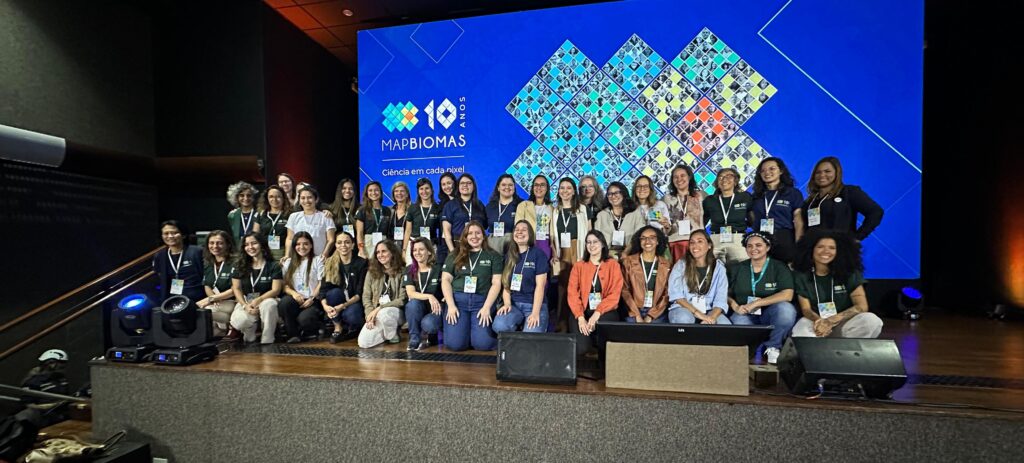
There are still few women working in the fields of science and technology compared to male participation. However, at MapBiomas, the presence of female scientists, researchers, and data specialists has been increasing within the teams, bringing essential diversity to the network's work.
“For the kind of science we do—meaning open, collaborative science that generates impact—diversity of age, expertise, regions, as well as gender, is fundamental,” says Julia Shimbo, scientific coordinator of MapBiomas.
Today, MapBiomas has women in leadership across different areas, such as data and map generation, management, institutional coordination, and communication, from different regions of Brazil and other countries. Of the 702 collaborators in the network's teams, 278 (about 40%) are women.
But there is more room for them to operate, says Julia. “This female presence needs to grow further in the areas of technology, platform development, and the use of AI (Artificial Intelligence),” Julia Shimbo comments.
In the month that celebrates International Women's Day, professionals from the network were invited to share a few words about what inspires them to work in their chosen fields, the challenges that exist for women in science and technology, and the aspects of MapBiomas they appreciate most.
Challenges for women in science and technology
One of the most highlighted challenges by these professionals is that, when it comes to working in science and technology, women feel they must constantly prove their value. Self-confidence is “always put to the test in environments that still question women's capabilities,” says Ana Paula Matos e Silva, from the Pasture and Agriculture team of MapBiomas Brazil.
“Stereotypes persist that associate science and technology with male roles, which often limits the recognition and visibility of women's technical knowledge,” evaluates Karen Andrea Huertas, who works on the production of land cover and use maps and at MapBiomas Alert in Colombia. “Added to this is the scarcity of support networks in highly technical areas.”
Inspiration to learn and space to contribute
When deciding whether to pursue or continue a career in science and technology, these professionals are inspired by female role models, a curiosity to learn more, and the desire to contribute to society and the environment, despite challenging scenarios.
“Working in direct contact with forests, wildlife, and local communities has always been exciting. Knowing that this work was important to protect both the environment and people made me believe I was on the right path,” says Sesilia Maharani Putri, coordinator of MapBiomas Fire Indonesia, regarding when she began working in the scientific field.
The desire to know more about the world led Taciara Zborowski Horst, from MapBiomas Soil Brazil, to enter this universe. “From an early age, I was driven by curiosity and the desire to understand how the world works. It was women, my professors at the university, who showed me that I could do science and lead my own research.”
Regarding MapBiomas, the professionals emphasize collaborative work as one of the network's strengths. “What excites me about the network is its collaborative nature, global reach, and, above all, the openness to testing new tools and proposals from its members,” says Mariana Guerra Lara, from MapBiomas Argentina.
For Natalia Cruzco, from the Atlantic Forest team of MapBiomas Brazil, the exchange of knowledge within the network is impressive. “The interaction and integration of different views on the same topic brings a unique richness to the final result.”
Check out the testimonials below:
Ana Paula Matos e Silva – MapBiomas Brazil

Ana Paula is part of the Pasture technical coordination and coordinates the Accuracy working group, in addition to supporting other countries in the network.
Inspiration: My inspiration comes from the livestock farming I experienced up close in the countryside of the state of Goiás. Pasture is something alive; it reacts to management, rain, drought, and care (or lack thereof). I also saw areas gradually lose productivity, almost without us noticing. That is where my desire to better understand these processes came from. Today, I work exactly with that: generating information that helps improve management, increase efficiency, and make livestock farming more balanced with the environment.
Challenges for women in science and technology: Having your self-confidence constantly put to the test in environments that still question women's capabilities. This fuels "imposter syndrome" and makes many people wonder if they truly belong in that field. Furthermore, pursuing a scientific career in Brazil is very unstable, which makes it harder to stay in science.
What impresses her about MapBiomas: The connectivity and interaction among everyone—it is a very collaborative effort. The engagement of the platform's users also catches my attention; they reach out, ask questions, and suggest improvements. This constant exchange strengthens the work and shows the real impact of what we do.
Andrea Barbieri – MapBiomas Uruguai
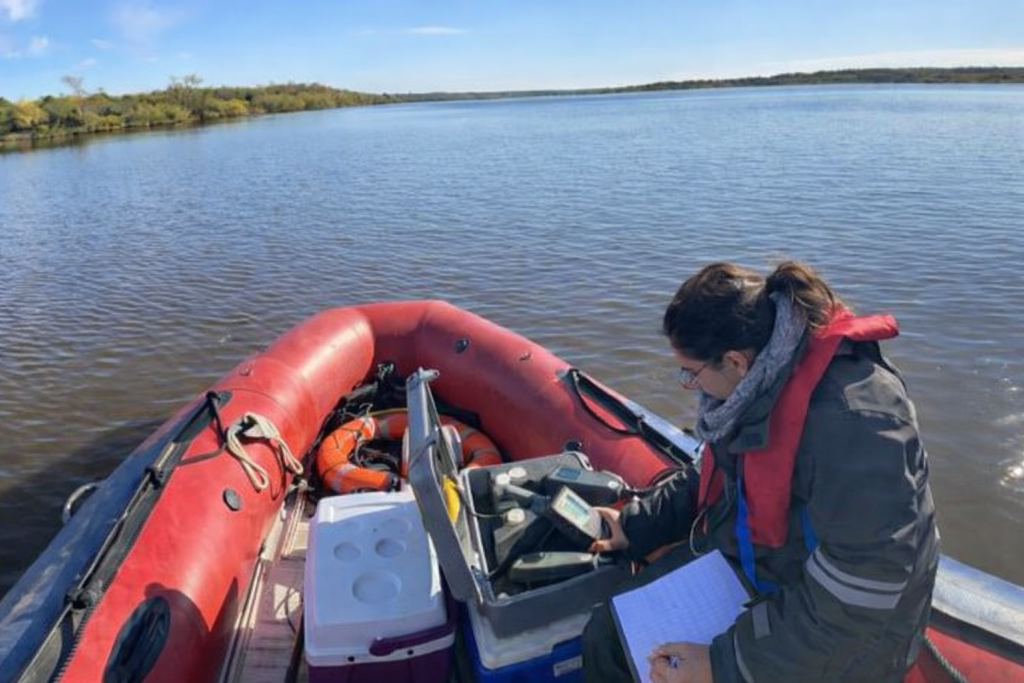
Andrea works as a technician at MapBiomas Water and develops initiatives for MapBiomas Uruguay.
Inspiration: I have always been inspired by my love for nature and the desire to contribute to the conservation of ecosystems, using data to demonstrate the current reality in order to raise public awareness.
Challenges for women in science and technology: For my generation and previous ones, the first difficulty was the low visibility of women in science. For many, this area wasn't even an option. Another major difficulty is having to constantly prove that my knowledge and technical opinion, as well as those of my female colleagues, are worthwhile.
What impresses her about MapBiomas: The ability to work in a network and contribute local knowledge to a regional effort. Also, the generosity in sharing knowledge through initiatives across various countries.
Bárbara Costa – MapBiomas Brazil

Bárbara works with the analysis and production of land use and land cover maps.
Inspiration: I always wanted to work with something that allowed me to study, learn new things, and exchange ideas. For a long time, I didn't even know that this was, in practice, being a scientist. Until, at the university, a professor said: "Being at a university means constant learning." That was when I realized I could turn my curiosity about things and the world into a profession.
Challenges for women in science and technology: Besides the well-known challenges like lack of appreciation and opportunities, we are constantly questioned. We often need to prove our capabilities more than men, whether regarding the quality of our work or the time taken to execute it. This ends up being an extra burden on the scientific and professional journey.
What impresses her about MapBiomas: Being able to contribute to something that has a real impact on the country is very motivating. I have the space to ask, propose ideas, and, most importantly, be heard. That makes all the difference.
Ethel Rubin de Celis Llanos – MapBiomas Peru

Ehtel works at MapBiomas Fire and Fire Monitor.
Inspiration: Generating free information so that measures can be taken at a national level is a spectacular way to transcend as a person, professional, researcher, and manager.
Challenges for women in science and technology: There is constant resistance from colleagues to recognize that things are changing toward a broader, more harmonious, and consistent vision—qualities that women possess.
What impresses her about MapBiomas: The network is the result of a common vision. There is a goal and an ideal of working together and doing it well.
Eva Molinedo – MapBiomas Bolivia

Eva works on the development of MapBiomas Water.
Inspiration: Knowledge itself. The more you learn, the more you realize that a much more complex and wonderful world exists, and that there is so much more to keep learning.
Challenges for women in science and technology: It is a bit complicated to break through in some areas, such as programming. Sometimes, people don't trust or they doubt your skills.
What impresses her about MapBiomas: The experiences shared between each country are unique, and collaborative work drives professional growth.
Gabrielle Abreu Nunes – MapBiomas Brazil

Gabrielle works in the Communication coordination of MapBiomas, connecting science, data, and society.
Inspiration: What inspired me to pursue science was, above all, the curiosity to understand and the desire to contribute to nature conservation, to better care for our ecosystems and, at the same time, promote human well-being. My inspiration comes from the possibility of producing knowledge with real impact, connecting science, public policy, and society. Also from the conviction that occupying this space is a way to broaden paths for those who come after me. The realization that female role models are lacking in the field turned into a sense of responsibility. I hope to be a source of support or a role model for girls and women who wish to pursue careers in science, technology, or science communication.
Challenges for women in science and technology: I see that the challenges are structural (and can be silent). One is the lack of representation. When we don't see women occupying certain spaces, such as leadership positions or technical areas, it becomes harder to imagine that place also belongs to us. Another challenge is implicit bias, which can manifest in competency evaluations, distribution of opportunities, and recognition of work. I also identify that in science, there is pressure for productivity in a competitive system that doesn't always consider inequalities in trajectory and access. Despite this, it is a joy to see more and more women transforming these challenges into collective strength! Creating support networks, expanding role models, and occupying strategic spaces is a fundamental part of the change.
What impresses her about MapBiomas: The network's ability to integrate universities, NGOs, public agencies, and specialists around a common goal, which is to produce reliable data about the Brazilian territory. I am also impressed by the culture of collaboration among technical teams. MapBiomas shows that network science is not just about technology and algorithms, but about trust, governance, and the collective construction of knowledge.
Karen Andrea Huertas – MapBiomas Colombia

Karen works on the production of land cover and use maps and at MapBiomas Alert.
Inspiration: The work of female scientists inspires me deeply. Seeing them lead complex scientific processes gave me the certainty that I could also occupy these spaces and pave the way for others to do the same. From a very young age, curiosity about how tropical ecosystems work guided my path. Science gave me the language to ask the right questions and technology gave me the tools to transform them into useful information, capable of telling the stories of the territory through maps.
Challenges for women in science and technology: Stereotypes persist that associate science and technology with male roles, which often limits the recognition and visibility of women's technical knowledge. Added to this is the scarcity of support networks in highly technical areas. However, initiatives like MapBiomas demonstrate that building science through networks—with trust, collaboration, and female leadership—is a concrete way to bridge gaps and change narratives.
What impresses her about MapBiomas: Its ability to bring together scientists from different countries with a common goal: generating open, timely, and useful information that leads to urgent and viable decisions regarding deforestation and climate change.
Mariana Guerra Lara – MapBiomas Argentina

Mariana works at MapBiomas Monte, Puna, and High Andes, and also in the network's Secretariat.
Inspiration: Since high school, I wanted to pursue a career with social impact, and I found in environmental sciences the possibility of combining my passion for nature with a commitment to contributing to society. During my training in Ecology, I discovered that research could be the professional career that integrates these interests. Currently, I am doing my PhD, researching biophysical and sociocultural factors that influence the conservation of the Caldén forest in Argentina. I am preparing my first publication as the lead author.
Challenges for women in science and technology: When I talk to colleagues in the scientific field, especially PhD fellows, one of the challenges that appears most is the so-called "imposter syndrome." The invisibility and underestimation of women in the workplace, particularly in STEM (Science, Technology, Engineering, and Mathematics) fields, has generated insecurities that today translate into lower confidence in our abilities, difficulty in sharing our ideas, and fear of making mistakes. On the other hand, caregiving tasks and child-rearing continue to fall disproportionately on women. This creates a constant tension between family responsibilities and the productivity and availability that a scientific career requires.
What impresses her about MapBiomas: What impresses and excites me most about the network is its collaborative nature, its global reach, and, above all, its openness to testing new tools and proposals from its members.
Mayumi Cursino de Morua Hirye – MapBiomas Brazil

Mayumi is part of the Urbanized Areas team and participates in discussions for Urban South America.
Inspiration: What led me to specialize in data production for cities was the possibility of translating the urban phenomenon—which is an expression of social territoriality—into something measurable and modelable, where data is essential.
Challenges for women in science and technology: I believe humans are equal in rights and duties, but there are cultural and hereditary peculiarities that are built and deconstructed over time, permeating all relationships and fields of action. The challenges for women involve overcoming inherited and reproduced behaviors that naturally place men in leadership positions and, specifically in technology, show a preference for male programmers.
Natalia Crusco – MapBiomas Brazil

Natalia is the technical coordinator for the Atlantic Forest team and participates in the MapBiomas Alert, Fire, and Degradation initiatives, among others.
Inspiration: What inspires me is the concrete impact our work generates in society—producing high-quality, reliable, and accessible data that supports strategic decisions at different levels. What also motivates me is our network model (open, transparent, and collaborative), which strengthens science through collective construction.
Challenges for women in science and technology: I think this pattern has been changing in recent years. At MapBiomas, for example, women have been occupying more space and taking on highly relevant positions. We have several inspirations/references of women within the network who help us encourage so many others to follow these fields. But it is always important to reinforce the need to ensure more inclusive environments and combat inequalities that still persist in science and technology.
What impresses her about MapBiomas: What impresses me most about the network is the exchange of knowledge and collaborative construction. The interaction and integration of different views on the same topic brings a unique richness to the final result.
Natasha Picone – MapBiomas Argentina

Natasha coordinates the Urbanized Areas mapping team.
Inspiration: I enjoy learning in general, but especially about environmental issues. Being able to do my small part to help improve these issues motivates me every day.
Challenges for women in science and technology: It is a challenge to reach management positions. On the other hand, I often see difficulty in understanding the different work paces we have because we take care of other things in daily life.
What impresses her about MapBiomas: The network's values seem fundamental to me: the collaborative generation of knowledge and information, and the open, free, and cost-less access to both products and methodology. I believe this gives the network enormous potential.
Sesilia Maharani Putri – MapBiomas Indonesia

Sesilia serves as the technical coordinator for MapBiomas Fire.
Inspiration: My first job involved collecting data around a conservation area. I needed to understand the characteristics of an entire landscape, so GIS software was essential to support the work. I was in my early 20s at the time, and working closely with forests, wildlife, and local communities was always exciting. Knowing that this work mattered to protect both the environment and people made me believe I was on the right path.
Challenges for women in science and technology: In many NGOs in Indonesia, especially those working with the environment, conservation, or field-based programs, the culture is still heavily male-dominated. Decision-making often happens in informal spaces, such as casual conversations, late-night chats, smoking breaks, or impromptu meetings that are not documented. When access to power depends on being present in these spaces, women are automatically excluded, not because of competence, but because of culture.
What impresses her about MapBiomas: The freedom with which technology and knowledge circulate within the network and to the public. The open collaboration between institutions and/or organizations makes MapBiomas truly unique, and it is this collective approach that allows the network to grow stronger over time.
Taciara Zborowski Horst – MapBiomas Brazil

Taciara works at MapBiomas Soil, coordinating and executing the development of national soil property maps.
Inspiration: From an early age, I was driven by curiosity and the desire to understand how the world works. It was women, my professors at the university, who showed me that I could do science and lead my own research. Since then, I have chosen as my path what seemed most challenging to build my scientific trajectory.
Challenges for women in science and technology: In my experience, the greatest challenge is not just accessing spaces, but being heard within them. Often, even when the contribution is consistent and technically solid, a woman only gains legitimacy when reiterated by men. There is a constant need to prove competence, authority, and merit until this barrier is effectively overcome.
What impresses her about MapBiomas: The genuine capacity for collaboration. I found an environment that values the collective, diversity, innovation, and technical responsibility. In topics related to natural resources, decisions require a solid scientific basis in the present, even as we continue perfecting data and methods. This understanding, which is at the core of MapBiomas, broadened my view on science: our research does not have a definitive result, but is a continuous process of construction, in which we produce, review, and improve, year after year, what we deliver to society.
Vera Laísa da Silva Arruda – MapBiomas Brazil

Vera is a technical coordinator at MapBiomas Fire.
Inspiration: I am driven by the possibility of transforming data into concrete decisions. Working with remote sensing and geospatial analysis inspires me because it connects science, technology, and real impact on the territory.
Challenges for women in science and technology: We still face inequality of opportunities, lower representation in leadership positions, and the constant need to prove technical competence.
What impresses her about MapBiomas: Seeing how the initiative has grown over the years, with more and more female leaders and a concrete concern for the representation of women in science and technology.